High-Grade B-Cell Lymphoma
Understanding Lymphoma and Chronic Lymphocytic Leukemia (CLL)
Introduction
High-grade B-cell lymphoma (HGBL) is a new category of B-cell non-Hodgkin lymphoma (NHL) introduced in 2008 by the World Health Organization (WHO).
This type of lymphoma is aggressive (fast-growing) and can be grouped in two subtypes:
- Diffuse large B-cell lymphoma/high grade B-cell lymphoma with MYC and BCL2 rearrangements (DLBCL/HGBL-MYC/BCL2). This subtype is characterized by permanent changes (mutations) called translocations in the parts of the DNA that contain the information for the MYC and BCL2 proteins. This category includes most NHL previously known as double/triple hit lymphoma.
- HGBL, not otherwise specified (NOS). This subtype includes aggressive B-cell lymphomas with mixed characteristics of other types of B-cell lymphoma such as DLBCL, Burkitt lymphoma (BL), blastoid-appearing large B-cell lymphomas, and lymphomas that do not have MYC and BCL2 translocation.
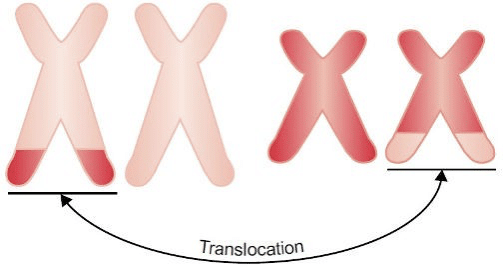
Figure 1: Example of a translocation, where a chromosome (a structure made of DNA and proteins found inside the cell) breaks and part of it reattaches to another chromosome.
Cancer cells in HGBL can look similar to B-lymphoblastic leukemia/lymphoma (B-LBL), BL, and DLBCL. Because of this, an expert review conducted by a hematopathologist (doctor who specializes in diagnosing blood diseases by examining cells and tissues) is important. The signs and symptoms of HGBL may also be similar to those of DLBCL and BL. These include:
- Painless, rapid swelling in the neck, underarms, or groin that is caused by enlarged lymph nodes. For some patients, the swelling may be painful.
- Night sweats.
- Fever.
- Unexplained weight loss.
- Fatigue (extreme tiredness).
- Loss of appetite.
- Shortness of breath.
- Pain.
For more information on HGBL diagnosis and symptoms, please view the Understanding Lymphoma and CLL Guide on the Foundation’s website (visit lymphoma.org/publications).
Treatment Options
HGBL is treatable, but in general is more likely to relapse (come back after treatment) than DLBCL. These lymphomas are generally treated with chemoimmunotherapy which consists of chemotherapy (drugs that stop the growth of or kill cancer cells) combined with immunotherapy (drugs that use the body’s immune system to fight cancer) such as monoclonal antibodies (proteins made in the laboratory that bind to markers at the surface of cancer cells and help the body fight cancer). The most common chemoimmunotherapy regimens include:
- DA-EPOCH-R (dose-adjusted etoposide/VP16 [VePesid, Toposar, Etopophos], prednisone [Deltasone and others], vincristine [Oncovin and others], cyclophosphamide [Cytoxan, Neosar], and doxorubicin/hydroxydaunorubicin [Rubex, Adriamycin PFS] plus the monoclonal antibody rituximab [Rituxan]). Monoclonal antibodies are proteins made in the laboratory that binds to cancer cells and helps the immune system destroy them.
- R-Hyper-CVAD/MA (rituximab plus hyperfractionated cyclophosphamide, vincristine, doxorubicin, and dexamethasone [Decadron and others], alternating with high-dose methotrexate [Mexate and others] and cytarabine/ high-dose Ara-C [Cytosar-U, Tarabine PFS]).
- R-CODOX-M/R-IVAC (rituximab plus cyclophosphamide, vincristine, doxorubicin, and methotrexate, alternating with rituximab plus ifosfamide [Ifex], etoposide, and cytarabine).
- RCHOP (rituximab, cyclophosphamide, doxorubicin, vincristine, prednisone).
- Pola-RCHP (polatuzumab, rituximab, cyclophosphamide, doxorubicin, prednisone)
- R-mini-CHOP (rituximab and reduced-dose CHOP) may be considered for patients who are older or frail.
- Biosimilar therapies (a biologic therapy [molecule that are created inside living cells] that is modeled after an existing biologic therapy or reference product already approved by the FDA) may be an option for patients who are taking rituximab (Rituxan). These include rituximab-abbs and rituximab-pvvr. For more information about biosimilars, please see the Biosimilar Therapies publication on the Foundation’s website (lymphoma.org/publications)
Treatment options for patients with HGBL who relapse or become refractory (do not respond to treatment) can include:
- Stem cell transplantation (SCT, the patient is treated with high-dose chemotherapy or radiation to remove their blood-forming cells or stem cells, and then receives healthy stem cells to restore the immune system and the bone marrow’s ability to make new blood cells):
- Autologous SCT (the patient’s own stem cells are used for transfusion).
- Allogeneic SCT (patients receive stem cells from a donor).
- Chimeric antigen receptor (CAR) T-cell therapy (a special form of immunotherapy that uses the patient’s own white blood cells, which are modified in a lab to target the cancer):
- The most common CAR T-cell therapy for HGBL includes lisocabtagene maraleucel (Breyanzi), tisagenlecleucel (Kymriah) and axicabtagene ciloleucel (Yescarta).
- For more information on stem cell transplantation and CAR T cell therapy, view the Understanding Cellular Therapy publication on the Foundation’s website (lymphoma.org/publications).
- Immunotherapy:
- Antibody-drug conjugates (ADC) consist of a monoclonal antibody attached to a chemotherapy drug. The monoclonal antibody in the ADC recognizes and binds to a protein on the cancer cell surface. Once the ADC is inside the cell, the chemotherapy drug separates from the ADC and kills the cancer cell by targeting cell multiplication. Common ADCs for the treatment of HGBL are loncastuximab tesirine (Zynlonta) and polatuzumab (Polivy).
- Monoclonal antibodies such as tafasitamab (Monjuvi) in combination with lenalidomide.
- Bispecific Antibodies:
- Bispecific antibodies recognize two different antigens, which can be on the same cell or two different cells. They are used to treat lymphoma are called T-cell engagers and work by linking cancer cells to healthy immune cells.
Compared with DLBCL, HGBL may have a higher risk of relapse in the patient’s central nervous system (CNS; the brain and spinal cord). To reduce this risk, some patients with HGBL may receive additional chemotherapy drugs to treat the CNS in addition to one of the chemotherapy regimens described above. CNS treatments may include methotrexate and/or cytarabine that is administered either intravenously (as a liquid that is infused directly into a vein), through a lumbar puncture (spinal tap) or both. A lumbar puncture is a procedure where a small needle is inserted into the back, some spinal fluid is withdrawn, and chemotherapy is injected directly into the cerebrospinal fluid surrounding the CNS.
Treatments Under Investigation
Many new treatments (also referred to as investigational drugs) and combination therapies (two or more drugs given at the same time) are currently being studied for the treatment of patients with HGBCL. Results from these clinical trials may improve or change the current standard of care (the proper treatment that is widely used by healthcare professionals and accepted by medical experts). The table below lists some of these investigational drugs that can be accessed through a clinical trial. For more information on clinical trials, view the Understanding Clinical Trials publication on the Foundation’s website (lymphoma.org/publications).
Table 1: Treatments Under Investigation for HGBCL in Phase 2 or 3 Clinical Trials.
| Agent (drug) | Class (type of treatment) |
|---|---|
| Sepantroniumbromide (SepB) | Targeted therapy; surviving inhibitor |
| Devimistat (CPI-613) | Targeted therapy; inhibitor of mitochondrial enzymes |
| Polatuzumabvedotin (Polivy) | Immunotherapy; antibody-drug conjugate, anti-CD79b |
| Nivolumab (Opdivo) | Immunotherapy; immune checkpoint inhibitor, anti-PD-1 |
| Glofitamab | Immunotherapy; bispecific antibodies, anti-CD20 and -CD3 |
| NoTafasitamab (Monjuvi) | Immunotherapy, monoclonal antibody, anti-CD19 |
| Retifanlimab | Immunotherapy; immune checkpoint inhibitor, anti-PD-1 |
| Zanubrutinib (Brukinsa) | Targeted therapy; BTK inhibitor |
| Orelabrutinib | Targeted therapy; BTK inhibitor |
| Acalabrutinib (Calquence) | Targeted therapy; BTK inhibitor |
| E7777 | Immunotherapy; fusion protein |
| Pembrolizumab (Keytruda) | Immunotherapy; immune checkpoint inhibitor, anti-PD-1 |
| Ontorpacept (TTI-621) | Immunotherapy; fusion protein |
| Maplirpacept (TTI-622) | Immunotherapy; fusion protein |
| Varlilumab (CDX-1127) | Immunotherapy; monoclonal antibody, anti-CD27 |
| Mosunetuzumab (Lunsumio) | Immunotherapy; bispecific antibody; anti-CD20 and -CD3 |
| Toripalimab | Immunotherapy; immune checkpoint inhibitor, anti-PD-1 |
| CRC01 | Immunotherapy; CAR T-cell therapy, anti-CD19 |
| Lenalidomide (Revlimid) | Immunotherapy; immunomodulatory drug |
| Inotuzumabozogamicin (Besponsa) | Immunotherapy; antibody-drug conjugate, anti-CD22 |
| Epcoritamab (GEN3013) | Immunotherapy; bispecific antibody; anti-CD20 and -CD3 |
| Relmacabtagene autoleucel | Immunotherapy; CAR T-cell therapy, anti-BCMA |
It is important to remember that today’s scientific research is always evolving. Treatment options may change as new treatments are discovered and current treatments are improved. Therefore, it is important that patients check with their physician or with the Foundation for any treatment updates that may have recently appeared.
Clinical Trials
Clinical trials are crucial in identifying effective drugs and determining the best treatment doses for patients with lymphoma. Patients interested in participating in a clinical trial should view the Understanding Clinical Trials fact sheet on the Foundation’s website (visit lymphoma.org/publications) or talk to their physician. The Foundation’s Lymphoma Resource Center can also be contacted for an individualized clinical trial search by calling (800) 500-9976, by emailing [email protected], or by submitting the Clinical Trials Search Request Form at lymphoma.org.
Follow-up
Patients with HGBCL should have regular visits with their physician. During these visits, medical tests (such as blood tests, computed tomography [CT] scans, and positron emission tomography [PET] scans) may be required to evaluate the need for additional treatment.
Some treatments can cause long-term side effects (occur during treatment and continue for months or years) or late side effects (appear only months, years or decades after treatment has ended). These can vary depending on the following factors:
- Duration of treatment (how long the treatment lasted).
- Frequency of treatment (how often the treatment was administered).
- Type of treatment given.
- Patient age and gender.
- Patient overall health at the time of treatment.
A physician will check for these side effects during follow-up care. Visits may become less frequent the longer the patient stays in remission (disappearance of signs and symptoms).
Patients and their care partners are encouraged to keep copies of all medical records. This includes test results as well as information on the types, amounts, and length of time of all treatments received. Medical records are important for keeping track of any side effects resulting from treatment or potential disease recurrences. Our Lymphoma Care Plan (lymphoma.org/publications) can help patients manage this documentation.
Lymphoma Care Plan
Keeping your information in one location can help you feel more organized and in control. This also makes it easier to find information pertaining to your care and saves valuable time. The Foundation’s Lymphoma Care Plan document organizes information on your health care team, treatment regimen, and follow-up care. You can also keep track of health screenings and any symptoms you experience to discuss with your health care provider during future appointments.
Patient Education Programs
The Foundation also offers a variety of educational activities, including live meetings and webinars for individuals looking to learn directly from lymphoma experts. These programs provide the lymphoma community with important information about the diagnosis and treatment of lymphoma, as well as information about clinical trials, research advances and how to manage/cope with the disease. These programs are designed to meet the needs of a lymphoma patient from the point of diagnosis through long-term survivorship. To view our schedule of upcoming programs, please visit lymphoma.org/programs.
Lymphoma Resource Center
The Foundation’s Lymphoma Resource Center staff are available to answer your general questions about lymphoma and treatment information, as well as provide individual support and referrals to you and your loved ones. Callers may request the services of a language interpreter. The Foundation also offers a one-to-one peer support program called the Lymphoma Support Network and clinical trials information through our Clinical Trials Information Service. For more information about any of these resources, visit our website at lymphoma.org, or contact the Lymphoma Resource Center at (800) 500-9976 or [email protected].
Para información en Español, por favor visite lymphoma.org/es. (For Information in Spanish please visit lymphoma.org/es).
© 2024 Lymphoma Research Foundation Last updated May 2024
Understanding Lymphoma and Chronic Lymphocytic Leukemia (CLL) is published by the Lymphoma Research Foundation for the purpose of informing and educating readers. Facts and statistics were obtained using published information, including data from the Surveillance, Epidemiology, and End Results (SEER) Program. Because each person’s body and response to treatment is different, no individual should self-diagnose or embark upon any course of medical treatment without first consulting with his or her physician. The medical reviewer, the medical reviewer’s institution, and the Foundation are not responsible for the medical care or treatment of any individual.
The Lymphoma Research Foundation appreciates the expertise and review of our Editorial Committee:
Co-Chair: Leo I. Gordon, MD, FACP
Robert H. Lurie Comprehensive Cancer Center of Northwestern University
Co-Chair: Kristie A. Blum, MD
Emory University School of Medicine
Jennifer E. Amengual, MD
Columbia University
Carla Casulo, MD
James P. Wilmot Cancer Institute
Shana Jacobs, MD
Children’s National Hospital
Patrick Conner Johnson, MD
Massachusetts General Hospital
Manali Kamdar, MD
University of Colorado
Ryan Lynch, MD
University of Washington
Peter Martin, MD
Weill Cornell Medicine
Lia Palomba, MD
Memorial Sloan Kettering Cancer Center
Tycel Phillips, MD
City of Hope
Pierluigi Porcu, MD
Thomas Jefferson University
Neha Mehta-Shah, MD, MSCI
Washington University School of Medicine St. Louis
Sarah Rutherford, MD
Weill Cornell Medicine
Supported through grants from: