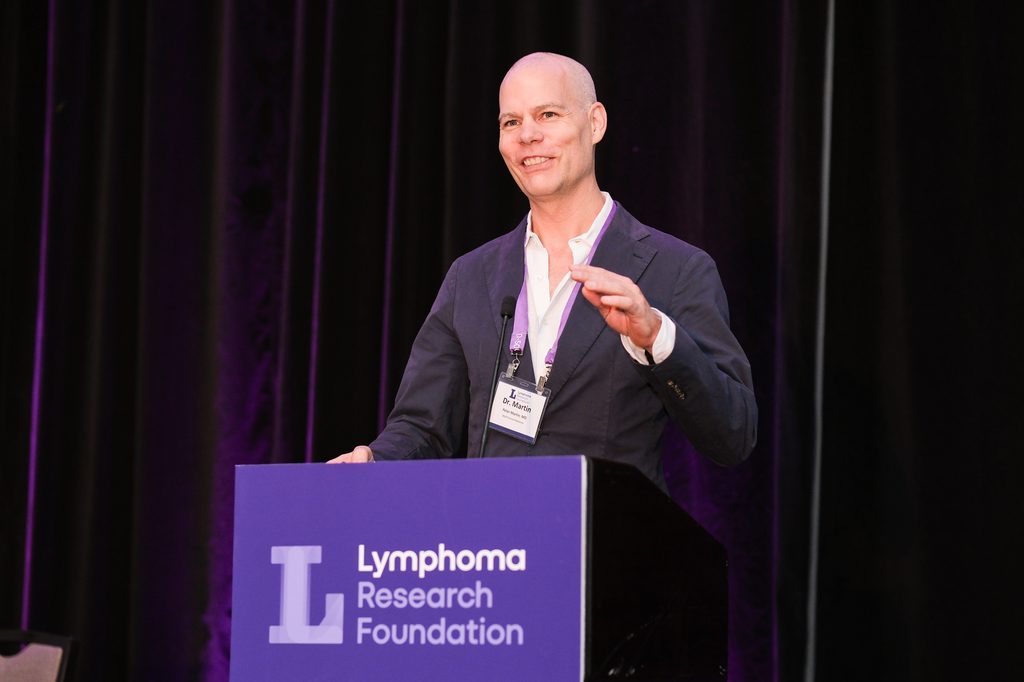
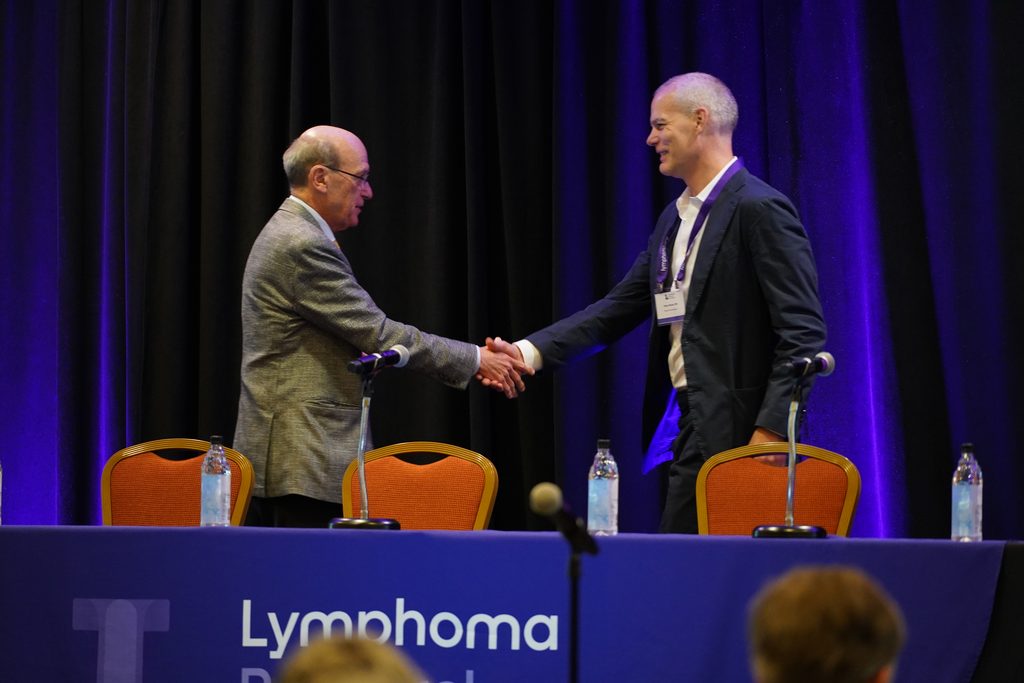
Driven by Curiosity, Dedicated to Patients: The Journey of Dr. Peter Martin
Home » News » Driven by Curiosity, Dedicated to Patients: The Journey of Dr. Peter Martin
News
Home » News » Driven by Curiosity, Dedicated to Patients: The Journey of Dr. Peter Martin
Driven by Curiosity, Dedicated to Patients: The Journey of Dr. Peter Martin
When Peter Martin, MD, looks back on the path that led him to become one of the world’s leading lymphoma specialists, he doesn’t point to a single defining moment.
Instead, he describes a journey shaped by curiosity, inspiring mentors, meaningful relationships with patients, and a desire to continually ask one simple question: How can we do better?
Today, Dr. Martin is a nationally recognized lymphoma specialist, researcher, and professor of medicine at NYU Langone’s Perlmutter Cancer Center, where he serves as co-chair of the Hematologic Malignancies Disease Management Group. This November, he will also receive the Lymphoma Research Foundation’s Distinguished Leadership Award in recognition of his extraordinary contributions to lymphoma research and patient care. Yet despite decades of accomplishments, he remains remarkably humble.
“I think we’ll all end up where we’re supposed to be,” he says. “This is just where I fit in the best.”
A Lifelong Curiosity
Growing up in Edmonton, Alberta, Dr. Martin was surrounded by science. His grandfather was a physics professor, his father a chemist, and his mother worked as an oncology nurse before transitioning into epidemiology. Although medicine wasn’t necessarily the obvious destination, scientific discovery would always be a part of his future.
“I always kind of knew I would be somewhere in science,” he recalls.
That curiosity eventually took him from Canada to Santiago, Chile, where he conducted molecular biology research after completing his undergraduate degree. Those early experiences reinforced his love of discovery while exposing him to different cultures and perspectives—qualities that continue to influence his work today.
Now based in New York City, where he has lived with his wife and son for more than 20 years, Dr. Martin balances a busy clinical practice with a thriving research program dedicated to improving the lives of people diagnosed with lymphoma.
Seeing the Person Before the Disease
For Dr. Martin, medicine has never been just about treating lymphoma.
“The relationship that I get to have with patients for years and years and years—I really enjoy that part of it,” he says.
His approach begins long before treatment decisions are made. Every new patient is an opportunity to understand not just a diagnosis but also a person.
“I always start off trying to learn as much as I can about this person, what’s important to them, who’s important to them. That sits at the center of everything.”
That philosophy also shapes the advice he gives patients and families navigating a lymphoma diagnosis.
Rather than expecting patients to become medical experts overnight, he encourages honest communication.
“Your job is to tell me how you’re feeling,” he says. “We’ll figure it out together.”
Research That Reaches Beyond the Clinic
Although caring for patients remains his favorite part of every week, Dr. Martin realized early in his career that he wanted to make an even broader impact.
As a clinical researcher, Dr. Martin helps design studies that evaluate new therapies, improve existing treatments, and answer important questions about how lymphoma behaves. For him, the most exciting part isn’t simply conducting research; it’s imagining new possibilities.
“I like forming the question and then coming up with the plan to answer the question,” he says. “That’s really the best part of clinical research.”
That same curiosity makes him a stronger physician.
“You see a situation and you say, ‘Boy, I wish we could do something better.’ Well, then as a researcher, you get to do something better.”
Transforming Mantle Cell Lymphoma
Over the course of his career, Dr. Martin has become internationally recognized for his work in mantle cell lymphoma (MCL), a rare and often aggressive subtype of non-Hodgkin lymphoma.
When he began focusing on MCL, progress had stalled for decades.
“There was recognition that we were seeing a lot of progress in other lymphomas and not as much in mantle cell lymphoma,” he says.
Rather than accepting a one-size-fits-all approach to treatment, Dr. Martin became interested in understanding why patients’ experiences with MCL differed so dramatically.
“I wanted to understand some of that diversity from person to person and be part of the team that helps move along newer and better treatments.”
Looking back over the past decade, he has seen remarkable progress.
“It’s been a pretty big paradigm shift,” he says of advances in mantle cell lymphoma research.
Yet he believes there is still much more work to do.
In 2024, Dr. Martin was appointed as chair of the Foundation’s Mantle Cell Lymphoma Consortium (MCLC). The MCLC was established in 2003 to advance research for this underserved patient population, and it is now a global network of nearly 150 researchers. As chair, one of his priorities is ensuring that momentum doesn’t slow. Under his leadership, the Consortium is currently working to better define high-risk forms of MCL so researchers can develop more targeted approaches for the patients who need them most.
I like forming the question and then coming up with the plan to answer the question. That’s really the best part of clinical research.
Why Research Can’t Wait
Over nearly two decades in lymphoma care, Dr. Martin has witnessed extraordinary scientific breakthroughs.
“The kinds of treatments we have today almost feel like science fiction,” he says. “It would have been hard to foresee where we are today 20 years ago.”
But from his perspective, progress never comes quickly enough. That urgency fuels his advocacy for continued investment in research.
“Over a million people are walking around with some form of blood cancer, and every single one of them deserves something better,” he says.
He believes scientific progress depends on both brilliant minds and sustained support.
“The people are there—they just need inspiration and time.”
Building the Next Generation
Dr. Martin has experienced firsthand how mentorship can shape a career, and he is passionate about creating those same opportunities for young investigators.
He credits mentors like John Leonard, MD (NYU School of Medicine), and Selina Chen-Kiang, PhD (Weill Cornell Medicine), with inspiring his own involvement in the Foundation early in his career, eventually leading him to serve on the Foundation’s Scientific Advisory Board.
Today, he encourages his mentees to become involved with the Foundation not only because it advances their careers but also because it allows them to make an impact far beyond their own clinics.
The Foundation’s investment in young investigators, he says, helps launch careers that can change the future of lymphoma treatment.
“I’ve seen people who came in fresh-eyed … later on be involved in clinical trials that literally change the treatment landscape.”
Finding Joy in the Lymphoma Community
Despite his leadership roles and research accomplishments, Dr. Martin measures success differently than most.
There isn’t one award, publication, or milestone that stands above the rest. Instead, his greatest career highlights happen every day.
“Every day you walk into the clinic, you see a familiar face that’s there,” he says. “You see them smiling back at you and know that you’re part of the reason they’re smiling. It’s hard to beat that feeling.”
As he prepares to receive the Lymphoma Research Foundation’s Distinguished Leadership Award, Dr. Martin views the honor not as recognition of past accomplishments, but as another opportunity to advance the Foundation’s mission.
“It’s an opportunity to help further the mission of the Foundation,” he says, “and contribute to the Foundation what the Foundation has contributed to my career and the careers of hundreds of my friends and colleagues.”
For Dr. Martin, the future of lymphoma research has always been about more than scientific discovery. It’s about people—the patients who inspire every question, every study, and every breakthrough, and the next generation of researchers who will carry that work forward.
The people are there—they just need inspiration and time.
Read More Articles from Pulse
Pulse is a publication of the Lymphoma Research Foundation, providing the latest updates on the Foundation and its focus on lymphoma and chronic lymphocytic leukemia (CLL) research, awareness, and education